
JEWELRY SIZING

When purchasing specific piercing jewelry, it’s important to know which dimensions you need. Think of it like buying shoes – if they’re too small, you’ll have one set of problems; if they’re too big, another. If you buy jewelry that’s too short, it will press against the piercing, potentially causing swelling and the jewelry to embed into the tissue. If you buy jewelry that’s too long, it won’t look good and will increase the risk of snagging.
In addition to the basic aspects such as gauge (thickness) and length or diameter, some jewelry types (especially labrets and attachments) require special attention to the thread type (internally threaded, externally threaded, or threadless). You can read more about jewelry types and threading here.
For certain piercing placements, there are “standard” jewelry dimensions, which simply means the most commonly used sizes. For example, a tragus piercing is usually done with jewelry that is 1.2mm thick and 7–8mm long (at the time of piercing), which can later be replaced with shorter jewelry once healed, depending on your anatomy (e.g. 6–7mm).
Jewelry dimensions vary depending on your anatomy as well as the piercer. Since there are no formal piercing schools, knowledge is passed from mentor to apprentice, meaning different piercers may use slightly different jewelry thicknesses or lengths for the same piercing.
Labrets

| POSITION | LENGTH | NOTES |
| Ear | For most ear and facial piercing placements, the labret thickness is 1.2 mm (16ga). | |
| Earlobe | 5mm – 9mm | The length of a labret depends on the thickness of the lobe. Average (healed piercing): 6mm and 7mm |
| Helix | 5mm – 8mm | The length of a labret depends on the thickness of the cartilage, but the angle at which the piercing sits should also be taken into account (for example, if the piercing has healed at a slant due to sleeping on it, a longer labret may be needed). Average (healed piercing): 6mm and 7mm |
| Forward helix | 4mm – 6mm | Average (healed piercing): 5mm |
| Tragus | 5mm – 8mm | Depending on the thickness of the cartilage and the depth of the piercing. Average (healed piercing): 6mm and 7mm |
| Antitragus | 8mm – 10mm | Depending on the thickness of the cartilage and the depth of the piercing. Average (healed piercing): 8mm and 9mm |
| Conch | 6mm – 9mm | Depending on the thickness of the cartilage. Average (healed piercing): 6mm and 7mm |
| Scapha (flat) | 5mm – 7mm | The length of a labret depends on the thickness of the cartilage, but the angle at which the piercing sits should also be taken into account (for example, if the piercing has healed at a slant due to sleeping on it, a longer labret may be needed). Average (healed piercing): 5mm and 6mm |
| Face | For most ear and facial piercing placements, the labret thickness is 1.2 mm (16ga). | |
| Nostril | 6mm – 8mm | Average (healed piercing): 7mm |
| Lip (side) | 6mm – 8mm | Average (healed piercing): 7mm |
| Lip (center) | 7mm – 9mm | Average (healed piercing): 7 mm |
Barbells

| POSITION | LENGTH | NOTES |
| Ear | ||
| Industrial | 30mm – 38mm | Thickness 1.6 mm (14ga) Average (healed piercing): 34 mm and 36 mm |
| Face | ||
| Bridge | 10mm – 16mm | Thickness 1.2 mm (16ga) & 1.6 mm (14ga) Average (healed piercing): 12 mm and 14 mm |
| Smiley | 6mm | Thickness 1.2 mm (16ga) |
| Tongue web | 6mm | Thickness 1.2 mm (16ga) |
| Tongue | 14mm – 20mm | Thickness 1.6 mm (14ga) Average (healed piercing): 16 mm and 18 mm |
| Nipple (M) | 10mm – 14mm | Thickness 1.6mm (14ga) |
| Nipple (F) | 12mm – 18mm | Thickness 1.6mm (14ga) |
Bent barbells

| POSITION | LENGTH | NOTES |
|---|---|---|
| Ear | ||
| Rook | 6mm – 8mm | Thickness 1.2 mm (16ga) Average (healed piercing): 6 mm |
| Snug | 8mm – 10mm | Thickness: 1.2 mm (16ga) Average (healed piercing): 8 mm |
| Face | ||
| Eyebrow | 4mm – 12mm | Thickness: 1.2 mm (16ga) Average: 8 mm (F) or 10 mm (M) The eyebrow is a placement that often experiences jewelry rejection, meaning the skin holding the jewelry can thin over time. Because of this, the jewelry length also depends on how old the piercing is (i.e., how much the body has pushed it out). |
| Torso | ||
| Navel | 6mm – 12mm | Thickness: 1.6 mm (14ga) Average: 8 mm and 10 mm The navel is another placement that often experiences jewelry rejection, so the skin holding the jewelry can thin over time. As a result, the jewelry length depends on how old the piercing is (i.e., how much the body has rejected it). |
Rings

| POSITION | DIAMETER | NOTES |
| Ear | For most ear and facial piercing placements, the ring thickness is 1.2 mm (16ga). | |
| Earlobe | 6mm – 14mm | The most commonly used size is 8 mm. The ring diameter depends on the distance between the piercing hole and the edge of the lobe. |
| Helix | 6mm – 10mm | The most commonly used size is 8 mm. The ring diameter depends on the distance between the piercing hole and the edge of the cartilage, but the angle at which the piercing sits should also be considered (for example, if the piercing has healed at a slant due to sleeping on it, you may need a larger ring). |
| Forward helix | 6mm | |
| Tragus | 6mm – 8mm | Depending on the thickness of the cartilage and the depth of the piercing. |
| Anti-tragus | 6mm – 10mm | Depending on the thickness of the cartilage and the depth of the piercing. |
| Conch | 10mm – 12mm | Depending on the width of that part of the ear and the depth of the piercing. |
| Rook | 6mm | |
| Daith | 8mm – 12mm | The initial size is usually 10 mm. If the cartilage in that part of the ear is thin, an 8 mm ring can be used once the piercing has healed. |
| Face | For most ear and facial piercing placements, the ring thickness is 1.2 mm (16ga). | |
| Nostril | 6mm – 10mm | The most common sizes are 7 mm and 8 mm. The ring diameter depends on the distance between the piercing hole and the edge of the nostril. |
| Septum | 8mm – 12mm | The initial size is usually 10 mm. |
| Lip (side) | 8mm – 10mm | The ring diameter depends on the distance between the piercing hole and the edge of the lip, as well as the thickness of the lip itself. |
| Lip (center) | 10mm – 12mm | The ring diameter depends on the distance between the piercing hole and the edge of the lip, as well as the thickness of the lip itself. |
| Smiley | 6mm – 10mm | The initial size is usually 8 mm. |
| Tongue web | 6mm – 10mm | The initial size is usually 8 mm. |
| Torso | Ring thickness 1.6 mm (14ga) | |
| Nipple (male) | 10mm – 16mm | Depending on anatomy and piercing depth. The most commonly used diameter is 12 mm. |
| Nipple (female) | 12mm – 20mm | Depending on anatomy and piercing depth. The most commonly used diameter is 14 mm. |
| Navel | 8mm – 10mm | Depending on anatomy and piercing depth. |
Size of attachments
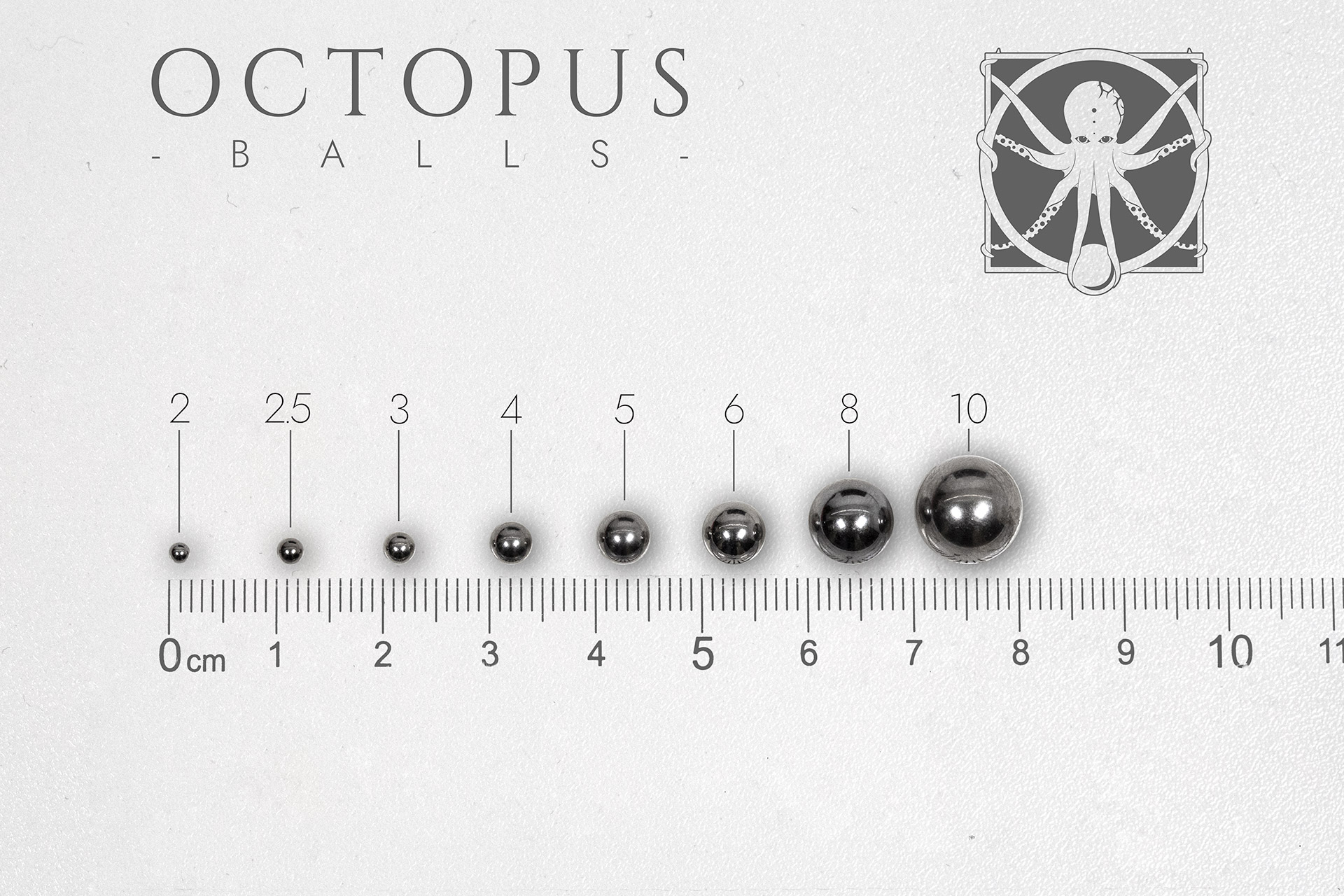
When purchasing attachments, it’s important to check:
- Do you already have a base onto which the attachment will be mounted (labret, barbell, ring, etc.)?
- Is the mounting system (internally threaded 0.8 or 0.9, clip-in, threadless, etc.) compatible with the chosen base?
Threaded extensions are divided into:
Internally threaded
- Inner thread (thread on the attachment) 0.9 mm (American) – for jewelry thickness 1.2 mm
- Inner thread (thread on the attachment) 0.8 mm (European) – for jewelry thickness 1.2 mm
- Inner thread (thread on the attachment) 1.2 mm (universal) – for jewelry thickness 1.6 mm
Externally threaded
- for jewelry thickness 1.2 mm
- for jewelry thickness 1.6 mm
Threadless attachments are divided into:
- Threadless – the newest mounting system, used by high-end jewelry manufacturers
- Push-fit – attachment for bioplast labrets
Attachments for ball closure rings:
- Clip-in
The listed purposes for each attachment size refer to the average dimensions most frequently requested by clients. For example, for bridge or nostril piercings, attachment up to a maximum of 3 mm are most commonly chosen. However, that doesn’t mean a 4 mm or larger one can’t be used if you prefer wearing slightly bigger jewelry.
The most commonly requested sizes for each body placement are shown in bold.
| BALLS, DISCS, SPIKES – threaded | |||
| Placed on: Labret, Bent barbell, Barbell, Circular barbell, Surface bar, Microdermal | |||
| SIZE | JEWELRY THICKNESS | PLACEMENT (position) | NOTES |
| 2mm | 1.2mm | Nostril Eyebrow Lip Forward helix Tragus Helix Scapha | A 2 mm extension is very small and can easily sink into the tissue. Because of this, it is recommended only for healed piercings. |
| 2.5mm | 1.2mm | Nostril Eyebrow Lip Forward helix Tragus Scapha Helix Lobe Conch Snug Anti-tragus Rook Bridge | |
| 3mm | 1.2mm | All placements suitable for jewelry thickness 1.2 mm | Most commonly used average size. |
| 1.6mm | Bridge | ||
| 4mm | 1.2mm | Lobe Helix Tragus Conch Septum Lip Surface | |
| 1.6mm | Nipple Navel (upper side) Industrial Surface Microdermal | ||
| 5mm | 1.2mm | Lobe Conch Septum | The weight of the ball can pull the jewelry downward on the lobe. |
| 1.6mm | Lobe Conch Tongue Nipple Navel (upper side) Industrial Surface Microdermal | ||
| 6mm | 1.2mm | Lobe Conch | The weight of the ball can pull the jewelry downward on the lobe. |
| 1.6mm | Lobe Conch Tongue Navel (lower side) | ||
| 8mm | 1.6mm | Navel (lower side) Tongue | |
If you’re buying jewelry as a gift and don’t know the exact dimensions that person needs, it might be a better idea to purchase a gift card. That way, the person receiving the gift card can come to the studio in person, and the piercers can help them choose the right model and exact dimensions.