
NEEDLE OR PIERCING GUN

In Croatia (and in the world) there is still a tradition of piercing the earlobes of very young children. Sometimes their ears are pierced before they are taken out of the maternity hospital for the first time. If you are thinking of getting your child’s (or your’s) earlobes pierced ‘quickly and painlessly‘ in a nearby jewelry store or shopping center, we recommend that you read the information on this page before making a final decision.
If you then decide that a piercing gun is good enough for you or your child, good luck. 🙂
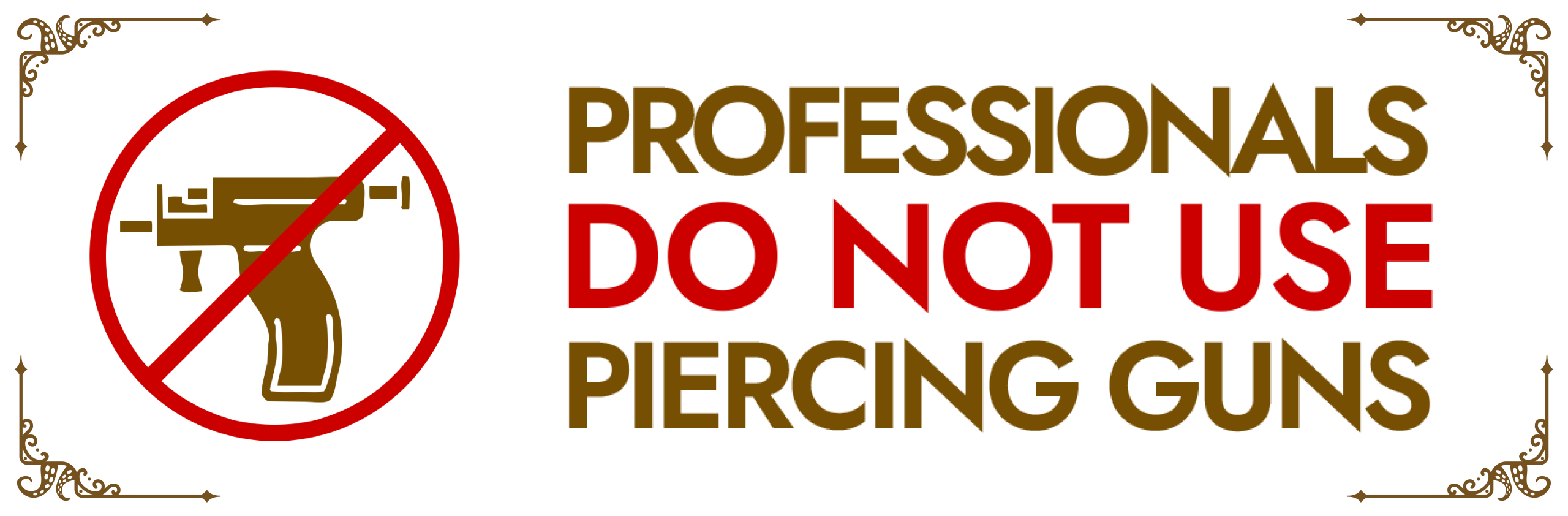
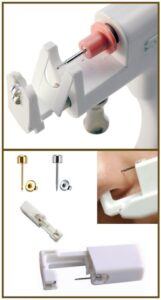
You’ve probably noticed jewelry stores with a sign in the window saying “Painless Ear Piercing.” That so-called “painless” ear piercing is done using a piercing gun, a device that looks like a small pistol with a built-in piercing mechanism. The front part of the system holds the earring, while the back holds the clasp that secures it, commonly known as a “butterfly” back or, in newer models, a “plug.” The earlobe is placed between these two parts, a button is pressed, and the device shoots the earring through the ear (much like a nail gun firing a nail).
Older models of piercing guns were 100% reusable, meaning the same device was used on many clients without any possibility of sterilization. Today’s piercing guns have a replaceable piercing system, the main device remains the same, but the part that comes into direct contact with the client is either replaced after each use or it was made cheap enough to be disposable. Unfortunately, this does not solve all the problems that can occur after piercing the body with a gun.
RISK OF INFECTIONS AND BLOOD TRANSMITED DISEASES
A piercing gun cannot be sterilized in an autoclave because it contains plastic parts. This means it can only be disinfected, which is by no means sufficient when it comes to piercing, which is essentially creating a fresh wound. During piercing with a gun, tiny particles of blood and tissue can be dispersed onto the device due to the force of the blunt earring being shot into the skin, which can then come into contact with the next client’s piercing. Always make sure the entire device is disposed of after each use.
Bacteria that naturally live on human skin and are harmless, until they come into contact with a wound, can also be transmitted from one person to another via a piercing gun. Keep in mind that bacteria are invisible to the naked eye, so a surface may appear clean even when it isn’t.
Fortunately, in Croatia, diseases such as AIDS and hepatitis are not as widespread as in some other parts of the world, but that doesn’t mean they don’t exist or that the risk of transmission should be ignored.
Disinfection is not the same as sterilization! Hygiene standards in piercing studios should be equivalent to those in hospitals (think of a clean hospital, Croatian ones may not be the best example). This means that only autoclave sterilization of tools and jewelry is acceptable.
An
NOT EVERYONE HAS THE SAME EARLOBE THICKNESS
The jewelry used with a piercing gun is standardized in both thickness and length.
If a person has thicker earlobes, the jewelry will be too short, which prevents proper healing and can eventually lead to swelling, inflammation, and the jewelry becoming embedded in the tissue.
In most cases, the so-called “medical” earring is not suitable even for earlobes, and using this method on other parts of the body is strongly discouraged.
Piercing jewelry will always be a foreign object in the body, and its shape must be anatomically suited to the part of the body where it is placed.
TISSUE DAMAGE DURING PIERCING
A piercing gun fires a blunt earring through the body part being pierced. The procedure itself is more painful than piercing with a needle, which is sharp and easily slips through tissue.
Piercing with a blunt object damages the tissue around the piercing site, which is a much bigger problem with ear cartilage than with the earlobe, which is soft.
Ear cartilage is connective tissue without major blood vessels, so it depends on the tissue that covers it for its nutrients.
If this tissue is damaged, various problems occur.

JEWELER VS. PIERCER
People who pierce ears in jewelry stores usually haven’t received any proper training related to bloodborne diseases or cross-contamination. They are simply handed the device and start piercing ears because it’s considered “the easiest thing in the world.”
In some jewelry stores, they don’t even wear gloves, which represents an extremely low hygiene standard.
The “training” required to use a piercing gun generally consists of reading the user manual – where to place the earring and which button to press to fire it. You’re “qualified” in under five minutes.
A jeweler will typically explain piercing aftercare something like this:
“Keep turning the earring so it doesn’t stick to your ear, clean it several times a day with alcohol or a strong disinfectant, and after a few weeks, change the jewelry to whatever you like.” Wrong, wrong, and wrong!
Turning jewelry in a fresh piercing irritates the wound, which often leads to swelling, scar tissue growth, or infection, especially since people tend to touch their piercings with unwashed hands or cause cross-contamination (for example, touching something dirty and then touching the piercing).
Applying alcohol or other strong disinfectants to a wound (and a piercing is a wound during the healing period) will also cause irritation around the pierced area. Alcohol is an effective disinfectant when used on intact skin, but when used on a piercing, it leads to irritation and drying of the skin around the jewelry. The skin becomes dry, red, overly sensitive, and painful to the touch. The jewelry can no longer move freely through the channel, as the dry skin tightens around it, meaning that any accidental movement will cause tissue damage, pain, and further irritation.
A piercing is considered fully healed only once the channel has epithelialized, i.e., when new skin has formed inside it. For earlobes, this healing period is around two months, while for cartilage piercings it ranges from 6 to 12 months. Healing times can vary depending on individual immunity and other factors.
Removing and reinserting jewelry prematurely damages the piercing channel and restarts the entire healing process. Since a piercing heals from the outside in, it may appear healed long before it actually is.
POOR JEWELRY QUALITY
Initial “medical” earrings for the ‘piercing gun’ are usually made from non-implant-grade materials, which can trigger allergic reactions in some people.
Jewelry used for an initial piercing should be made from implant-grade titanium (Ti6AL-4V ELI, ASTM F136) or implant-grade steel (316L, ASTM F138, ISO 5832-1).
The clasp on the back of the earring is practically impossible to clean thoroughly and carefully when it comes to a new piercing. Lymph, plasma, and dead skin cells collect in its grooves, creating the perfect environment for bacterial growth. Sleeping with a “butterfly” clasp guarantees nightmares, as the earring will poke you every time you press against it.
Silver and gold are not implant-grade materials!
Bone plates, pacemakers, and other medical implants are not made of gold, they’re made of titanium. Keep that in mind when choosing piercing jewelry that you’ll be wearing inside your skin for several months without removal.
ASYMMETRICAL PLACEMENT
People who use a piercing gun generally don’t ensure that your ears are pierced symmetrically. In most cases, they don’t even mark the piercing spot beforehand so the client can see and approve it.
Everyone’s earlobes are shaped differently, and some anatomies are more challenging for proper and symmetrical placement. For people with very small or narrow earlobes, it’s important to make sure the piercing isn’t placed too low, as over time the hole can stretch (especially from wearing heavy earrings) and may eventually tear.
One of the reasons we don’t pierce earlobes on children under the age of 12 is that their bodies are still developing, meaning their ears won’t be the same shape or size at age 2 as they are at age 12. We often have clients whose ears were pierced in early childhood and who now want to add a few more piercings to their earlobes. This can sometimes be a problem because the original (old) holes were pierced asymmetrically, too low, or too high, making it difficult to create a neat, anatomically aligned row that follows the natural line of the ear.
PROBLEM SOLVING
One advantage a piercer has over an ‘earring gun operator’ is their expertise and training in what they do. People who pierce the ears with a gun are primarily in the business of selling jewelry, not piercing. They’re probably great at selling gold earrings with diamonds, but if your pierced ear gets infected or has any other problem, the only advice they can give you is to take out the jewelry and see a doctor. As soon as the jewelry is taken out and the piercing is infected, the hole will close and you’ll be left without a piercing. The doctor will probably prescribe a course of antibiotics and ‘problem solved’.
The main goal of the piercing profession is to create beautiful, long-lasting, and healthy piercings. Your piercing is a reflection of our work and experience — not just a showcase for the jewelry we sell. We strive to perform every piercing with the highest level of care, whether it’s an earlobe piercing with our most affordable jewelry or symmetrical nostril piercings with branded gold pieces set with gemstones.
If you ever experience a problem with your piercing, your piercer is there to help you – years after the procedure. As mentioned before, piercing jewelry is a foreign object, and the body needs time to accept it, sometimes even a few years (depending on the location and other factors). Not every problem should be solved by removing the jewelry and taking antibiotics. A large part of the responsibility lies with the client to notice any issue early and visit the piercing studio for a check-up as soon as possible.
One of the main reasons why goldsmith’s ear piercing is so widely accepted and popularized is its financial affordability. Ear piercing in a jewelry store usually costs around 4.00 euros or is free with the purchase of their pistol earrings, which cost up to about 10.00 euros on average. We hope that with this text we have been able to clarify that the difference between piercing with a gun and a needle is not only in money, and that it is worth investing in your own health or the health of those you love the most.
If you’re considering piercing the ears of a child so young that they still can’t speak, please think about the following – no matter how quick the procedure is, ear piercing is not completely painless, and your child will feel that pain. A small baby needs to feel complete safety and comfort from their parents (especially the mother), as it is powerless to protect itself.
If you, as a mother, firmly hold your small baby who cannot understand what’s happening, while a stranger causes them pain (by piercing their ears), it may create trauma or a sense of mistrust in the child, as they cannot rely on you to protect them from pain. There are no scientific studies on this topic, and this statement is not supported by scientific evidence. But please think about it before putting your child in that situation.
If they absolutely must have earrings, for whatever reason, wait at least until your child is old enough to understand when you explain that the piercing will hurt and that they must not touch the earrings with their unwashed little fingers.
‘TRADITION’ IS PEER PRESSURE
FROM THE DEAD
For some people, getting a piercing goes smoothly without any issues, while others end up in the emergency room because of it. The healing of a piercing depends on many factors, from the piercing method and equipment used, the jewelry itself (shape, material, dimensions), how well the piercing is cared for, your immunity and habits, accidental snagging or impact, and more.
No one can guarantee that everything will always be fine with your piercing. Jewelry is a foreign object, and various inflammations or infections are possible, especially during the healing period. That’s why it’s important to carefully consider the conditions in which you’re getting your piercing and to choose a piercer who can help you in case any problems arise.
How and with what you choose to get pierced is entirely your decision and responsibility.