
Tattoo problems

Compared to piercing – which can potentially cause issues throughout the entire period of wearing it – a tattoo is much easier to maintain, and once it has healed, the possibility of complications is practically non-existent.
FIRST 10 DAYS AFTER TATTOOING
During the first ten days after tattooing, you need to pay more attention to tattoo care. After the surface layer of ink peels off, it will still be necessary to continue moisturizing the skin for at least another month until full regeneration.
A tattoo is a superficial wound and must be protected from contact with anything that can irritate or damage it in any way (dirt, chemicals, fabric, pet hair, etc.). It is protected with wrap, which blocks air flow to the wound and can cause inflammation. For this reason, it is important to properly and regularly care for a fresh tattoo, because inflammation, infection and other problems result in poor color quality. All of the above issues most commonly occur due to wearing protective wrap for too long and too often, and applying too thick a layer of ointment on the tattoo.
Do not submerge a fresh tattoo in water for at least 4 weeks after tattooing to avoid possible infections, ink blowouts and/or color damage.
If you notice any concerning change on the skin, you must contact Octopus studio for a check-up as soon as possible!
SWELLING
For larger tattoos, swelling is normal in the first few days and is no cause for concern. You can reduce swelling by applying cold compresses over the wrap. You should contact us if the swelling does not go down within 2-3 days after tattooing, or if you have a small tattoo that has started to swell.
REDNESS
Depending on the size and placement of the tattoo, redness may be more or less pronounced. Applying cold compresses over the wrap also helps in this case. Redness should disappear 2-3 days after tattooing. Medical adhesive tape (used to secure regular plastic wrap) can irritate the skin and cause redness.
SCABS
Scabbing on a fresh tattoo must be avoided, as when scabs fall off they pull ink from the deeper layers of the skin, resulting in “holes” in the tattoo. A scab forms when plasma and lymph coagulate on the surface of the skin. This happens if you let the tattoo dry out (i.e. it is not constantly moisturized), or when fabric sticks to the wound.
INFECTION
A fresh tattoo can become infected if it comes into contact with dirt or chemicals. Infection is usually quite painful, the area of the tattoo is swollen and hot to the touch, and there may be a whitish purulent discharge from the tattoo.
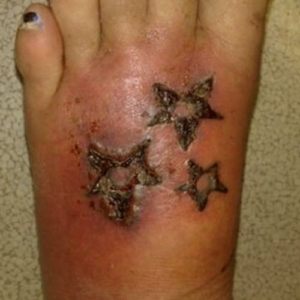


(Examples taken from the Internet, tattoos are not our work.)
LYMPH, BLOOD AND INK LEAKING
This is a normal occurrence after tattooing and is no cause for concern. For small tattoos the discharge may be barely noticeable, while with larger tattoos you may leave a black trail behind you like a squid. If the discharge is heavy, during the first few days you can tape a piece of paper towel to the edges of the wrap to absorb the blood and ink.
BURNING AND ITCHING
These are normal parts of the healing process and are no cause for concern. The tattoo will burn intensely if it comes into contact with anything hot, so do not use very hot water when washing the tattoo. Sometimes the itching becomes unbearable; you can relieve it by placing a cold compress over the wrap.
PIMPLES
If you notice pimples on the tattoo, do not squeeze them as this can damage the delicate skin that has just begun to cover the tattoo, and may also cause ink to be pushed out in that area. The most common causes of pimples are applying too thick a layer of ointment or cream, and wearing protective wrap too often.
PEELING OF INK
When the tattoo begins to heal, the surface layer of ink will start to peel and fall off. This is also normal and not alarming. With small tattoos this process may not be visible, but with larger tattoos the ink flakes off in fairly large pieces. Do not pick or peel the ink intentionally—let the process happen naturally to avoid damaging the tattoo.
Once peeling is finished, the tattoo is surface-healed.
THE NEXT MONTH
After surface healing, deep regeneration of the skin damaged by tattooing follows; the layer of new skin that has formed over the tattoo gradually becomes thicker and stronger.
The tattoo will continue to look “flaky” for a while and you may feel tightness of the skin in that area. In this phase, it is important to keep the tattoo moisturized and protect it from prolonged direct sun exposure. You can use any moisturizing cream as needed, as long as you do not apply it in a thick layer.
Avoid swimming in the sea, pool, river, or lake, as well as soaking in a bath or jacuzzi, for at least the first 4 weeks after tattooing. It is also advisable to avoid saunas, tanning beds, and prolonged sun exposure.
UV rays act like a miniature laser for tattoo removal – they break down the tattoo pigment which then enters the circulatory system, causing the tattoo to fade faster. Avoiding the sun does not mean that in the months following your tattoo you must live like a vampire hiding in the shadows. The tattooed area will not fall off if a ray of sun touches it. However, if you sit outside for coffee on a terrace and it’s over 18ºC, a tattoo exposed to direct sun may start to burn – especially if it is a large design or has a lot of solid black fills. For at least the first three months, use SPF50 sunscreen to preserve the colors of your new tattoo.
FULLY HEALED TATTOO
A few months after tattooing, the skin will be fully regenerated and the tattoo will take on its long-term appearance. The only thing you should continue to do is protect it with SPF30 or higher during prolonged sun exposure in the summer months, as this will preserve the color intensity and make the tattoo look new for longer. The skin that grows over the tattoo is not transparent – it has its own natural pigment. For this reason, colors always look more intense when the tattoo is new. When you tan in the sun, the tattoo colors will look more muted, and white ink may appear brown or yellow depending on your skin type. When your skin lightens again in winter, the colors will return to normal.
The only problems that can potentially occur after full healing are injuries to the skin in the tattooed area. Depending on your skin type, the injury may result in different kinds of scars. Scars are areas of connective tissue (fibrosis) that replace normal skin after injury. A scar is connective tissue (fibrosis) that replaces the part of the skin after an injury. Scar tissue is composed of the same protein (collagen) as the tissue it replaces, but it is structured differently.
TYPES OF SCARS
HYPERTROPHIC SCAR
It forms within the boundaries of the injury, with a thin layer of reddened skin growing from the base. It appears as a small fleshy bump.
KELOID SCAR
It is darker in color and extends beyond the edges of the wound. People with darker skin, which contains more melanin, are more prone to keloids, and they can grow up to the size of a golf ball.
ATROPHIC SCAR
A sunken (depressed) scar.
You can tattoo over scars, but lines usually come out uneven and ink often spreads under the skin. If you have suffered an injury that damaged your tattoo, book an appointment for a check-up and consultation so we can see what can be done in terms of touch-up.